
6 minute read
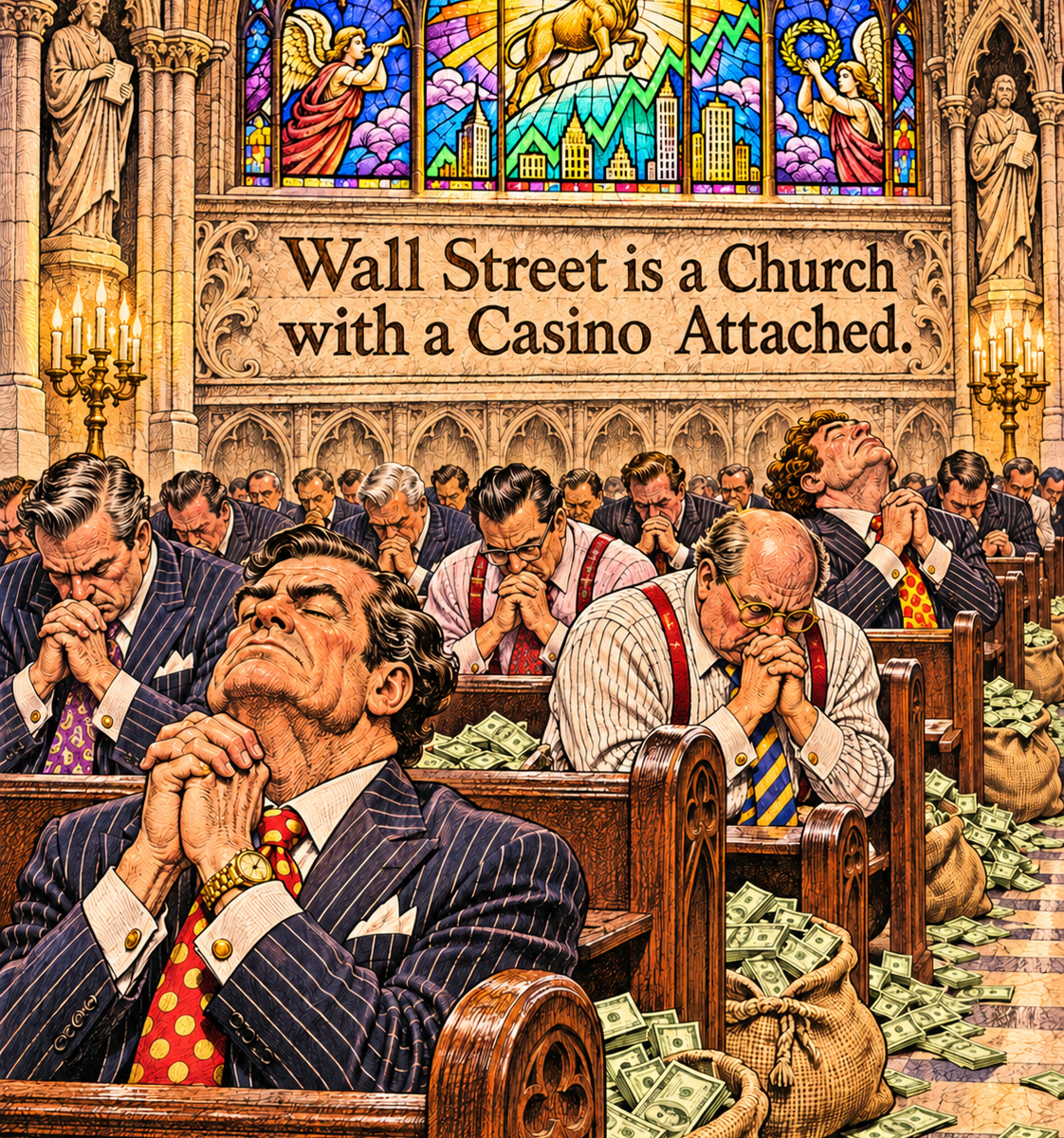
(*Quote inspired by Warren Buffett, who said that the stock market is a church with a casino attached. He also said in July of 2026: “It’s tough to find values when everybody is preferring gambling.”)
On August 26, 2026, when Meta settled in court to pay $16.7 billion for harming children, its stock price surged +5%. When the Internet bubble popped in 2001, Amazon’s stock price dropped 93%. In September of 2018, when Musk was filmed taking a puff of marijuana on a podcast, Tesla lost $3 billion in market value the next day. On November 5th, 2026, the Nasdaq dropped 5% and lost $2.8 trillion in value following the midterm elections (blue wave), then rallied the following day. Nvidia lost $443 billion in market cap mid-November 2026 after Jensen Huang admitted to having an affair with a Chinese spy. Not only is Wall Street, or Mr. Market, sporadic and schizophrenic in the short term, but when he’s happy he’s dangerously euphoric and when he’s sad he’s dangerously depressed. This impulsive nature stems from an almost religious fervor for speculation. Right now we are living through a euphoric embrace of AI technology, AI infrastructure, and AI-related stocks. One of my favorite quotes from The Intelligent Investor by Benjamin Graham, concerning the vicissitudes of the market and whether to trust them:
‘Would you willingly allow a certifiable lunatic to come by at least five times a week to tell you that you should feel exactly the way he feels? Would you ever agree to be euphoric just because he is – of miserable just because he thinks you should be? Of course not.’
We shouldn’t let Mr. Market, who is currently soaring on a meth binge, distort our perspective on AI, its impact in the next 2-4 years, and the real values of the companies in this sector.
Let us continue with Benjamin Graham, to understand why a church has inevitably built around the rise of AI, in which our current financial system is deeply leveraged:
‘The typical money manager, however, has no choice but to mimic Mr. Market’s every move – buying high, selling low, marching almost mindlessly in his erratic footsteps. Here are some of the handicaps mutual-fund managers and other professional investors are saddled with:
‘With billions of dollars under management, they must gravitate toward the biggest stocks – the only ones they can buy in multimillion dollar quantities they need to fill their portfolios. Thus many funds end up owning the same few overpriced giants.’
Think Nvidia, Alphabet, Amazon, Microsoft…tech companies are the current overpriced giants. 8/10 of the largest companies in the world (in terms of market capital) are in the tech sector.
With AI now, there’s also a sense of FOMO: hedge funds and investors have been witnessing the incredible returns of AI related stocks for the past three years and don’t want to miss out on these gains.
‘Investors tend to pour more money into funds as the market rises. The managers use that new cash to buy more of the stocks they already own, driving prices to even more dangerous heights.’
Coupled with this handicap is the hype machine around AI; investors justify this move with the belief that AI will dramatically change our world for the better, in the short term.
When the AI bubble bursts, the drop will be accelerated by the following phenomenon:
‘If fund investors ask for their money back when the market drops, the managers may need to sell their stocks to cash them out. Just as the funds are forced to buy stocks at inflated market prices in a rising market, they become forced sellers as stocks get cheap again.’
The panic will also be exacerbated by the fact that talk of an AI bubble is now common parlance: money managers will desperately pull out to not lose their gains. There will be an avalanche effect.
Wall Street is also a church due to its short term, distortion-field incentives:
‘Many portfolio managers get bonuses for beating the market, so they obsessively measure their returns against benchmarks like the S&P 500 index. If a company gets added to an index, hundreds of funds compulsively buy it. (If they don’t, and that stock then does well, the managers look foolish; on the other hand, if they buy it and it does poorly, no one will blame them.’)
We have also seen examples of AI specialized hedge funds, like Situational Awareness, have incredible success (then failure) enticing more Wall Street players to jump in the game. Situational Awareness was founded in 2024 by a 22-year-old valedictorian named Leopold Aschenbrenner who left OpenAI, wrote an essay, and began with only $225 million in seed capital. By June of 2026, the firm had $20 billion in assets, a 439% growth over the previous year. Then the firm, which had bought stocks on margin (borrowing money to make bigger bets) imploded, causing Citadel to sweep in. Or take Brad Gerstner, who started with $3 million to launch Altimeter in 2008, and now, this past March 2026, manages $18.75 billion. Brad’s three largest holdings (as of June 2026) are Nvidia, Cerebras, and Meta. The upper echelons of Wall Street are part of an inside club, chummy with Trump, and these stories of skyrocketing funds add to the frenzy.
‘Increasingly, fund managers are expected to specialize. Just as in medicine the general practitioner has given way to the pediatric allergist and the geriatric otolaryngologist, fund managers must buy only ‘small growth stocks’ or only ‘mid-sized value’ stocks, or nothing but ‘large blend’ stocks. If a company gets too big, or too small, or too cheap, or an itty bit too expensive, the fund has to sell it – even if the manager loves the stock.’
In November 2026 there are currently 200+ venture capital funds that self-describe as ‘AI-focused.’
Just as religion and church-going acts as a soothing balm to anxieties and doubts, encouraging disciples to continue their attendance, success in Wall Street and increasing gains acts as a reinforcing, enticing force.
‘After an event occurs just two or three times in a row, regions of the human brain called the anterior cingulate and nucleus accumbens automatically anticipate that it will happen again. If it does repeat, a natural chemical called dopamine is released, flooding your brain with soft euphoria. Thus, if a stock goes up a few times in a row, you reflexively expect it to keep going, and your brain chemistry changes as the stock rises, giving you a ‘natural high.’ You effectively become addicted to your own predictions.’
The level of dopamine being injected into Wall Street now via AI-related stocks rising and rising is clouding out reason. Imagine the dopamine rushes of turning millions into billions! Of course AI is going to save the world! It has to!
On November 7th 2026, Jeff Yass published an Opinion piece in the Wall Street Journal entitled, « There’s no such thing as a stock market bubble. » It’s important to take everything he writes with a grain of salt, since he’s a billionaire money manager (the richest man in Pennsylvania) who has billions invested in tech stocks like Nvidia, Micron, and Taiwan Semiconductor, but his essay is the equivalent to standing outside a church and hearing the choir chant or sing. He argues that the high prices we are witnessing on the stock market are a result of uncertainty and probability; we don’t know who the major winners will be in AI so all of them are overpriced, just like during the dot.com boom when Pets.com (bankrupt in the crash) and Amazon (went on to become a $2.8 trillion company) were vying for investors’ cash.
What Jeff ignores is all the excess, waste, and risk being pulled into this betting vortex. It ignores that society, mostly working class people with pension funds and small businesses who can’t get a loan, are being hurt by Wall Street’s speculations on who will be the winner. It ignores what else all this money could be invested in. It ignores that a financial crisis or a global depression will harm everyone. If our experience is similar to the asset bubble burst in Japan in 1989, it could take us 34 years to return to the current level/value of the market.
Let’s hope the current legislation being worked on by Democrats denying the government’s power to bail out AI companies passes in time.
But wait, didn’t I just write that Wall Street is its own inside club? Can’t we just let boys be boys and let them sing in their church and shoot craps in the pews? No, because they have created debt and bonds to fuel their insatiable hunger, and these instruments are tied to reality and can impact the rest of the financial system.
Meet the Special Purpose Vehicle, the SPV, the A.I. Boom’s version of the CDO (collateralized debt obligation) during the subprime mortgage crisis.
An AI infrastructure company or hyperscaler wants to build a data center, but doing this is VERY expensive and will make their balance sheets look bad (which investors don’t like and which could prevent the company from receiving more loans in the future). So rather than use their own cash, they create a SPV, which is like a mini-company with a different name, and using the SPV they raise debt, slice the debt into tranches, and sell the tranches to asset managers, banks, and institutional investors. Those banks, asserts managers, and institutional investors handle our savings and retirement accounts, and if they suffer significant losses, we will too.
When a contract is signed between the creators of the SPV (like a neocloud such as CoreWeave, an AI infrastructure company competing against the hyperscalers) and a client, such as Anthropic or OpenAI, the money paid by the client does not go to the neocloud right away, but first pays to operate the data center then the SPV. The money that Anthropic and OpenAI are spending (they are burning billions in cash to stay on the cutting edge of the frontier and accumulating enormous losses) comes from billions of investment speculation, much of it from those AI-specific hedge funds mentioned before.
So it’s like a waterfall:
Torrent Origin: Hedge funds and Wall Street are super excited and greedy about AI and pump billions into Anthropic and OpenAI.
- Anthropic or OpenAI uses their money to pay for compute, and makes commitments for continuing to pay billions for compute over the ensuing years.
- The payment covers data center operating expenses.
- The remaining funds go to creditors.
- Then (if anything is leftover) the holding company (i.e. CoreWeave) gets paid.
SPVs also have a feature called a Debt Service Coverage Service Ratio (DSCR), which requires a certain amount of income to be gained relative to its debt. A DSCR of 1.10 and a monthly payment of $100 million (lowballing here) means that $110 million needs to be earned in revenue after operating expenses. These contracts are set to take effect on dates when a data center is theoretically operational, so if there are delays this could all go catastrophically wrong (Oracle is shipping natural gas via trucks, which is expensive, while a pipeline is being built, Anthropic just spent $39 billion on gas turbines). The new Texas governor, a democrat named Gina Hinojosa, has announced putting a moratorium on data center approvals until new laws are established. The U.S. has a severe bottleneck on electricity. Another reason why Three Mile Island, where there was a nuclear disaster, is being reopened by Microsoft. Larry Fink, CEO of BlackRock, has announced that a moratorium on data centers would cause a recession.
An SPV also requires a minimum of liquidity and a debt service liquidity account (DSRA) to be set up as a buffer if payments fall through.
To sum all this up, giant asset managers and financial whizzes (the founders of CoreWeave have boasted that they brought financial innovation through their previous work as gas hedge funds managers to the computer chip world, using their GPUs as collateral to receive massive loans) are doing everything they can to create safeguards for the debt of data centers/SPVs to be paid off, but this is all premised on continual, explosive demand for compute and for the holding companies of the SPVs to remain out of bankruptcy. And don’t forget that these GPUs have expiration dates.
So why exactly are the Hyperscalers and neoclouds engaged in all this risk-shunting madness? The SPV allows them to receive more money and build the data center faster than if they only used their own cash. And they don’t want to be left behind. Their hope is that AI becomes integrated into everything we do, into the very fabric of human society, and that we all pay consistently and substantially into this fabric. If that is the case (see Chapter 7 on A Vision of Superintellience) then they sit back, relax, and receive cash each time one of their GPUs is rented by Anthropic or OpenAI (after the creditors have been paid off of, of course). Easy money.
Because of the nature of these SPVs, which are also used by the hyperscalers to hide the debt and keep their balance books looking less like a CapeX disaster, the precise scale of the data center buildout is unknown. But as outlined in the precious chapter, it has been estimated to be over $1 trillion.
To keep the choir singing, to justify all these SPVs being created and pay off the debt that’s being repackaged and sold to all corners of the financial system, money for compute needs to REALLY start coming in, from sources other than Wall Street and hedge funds. Will average people pay the REAL cost for the compute that they’re using to create videos of Jensen Huang grinding with Alice Huang at a Coldplay concert?
As of this writing, it is estimated that 70% of the compute being purchased from Amazon, Google, and Microsoft [who have about 12.4 million AI accelerator chips] comes from two players: Anthropic and OpenAI. The success of Wall Street’s church/casino is riding on the success of these two, hype-hungry firms.
Now let’s learn more about these frontier labs/players drastically inflating this debt-asset bubble.
They’re the focus of congregation. How long will they inspire those attending the service to keep the faith?