INTERVIEW (2.5 minute read): After years of rumors, it’s official: everything that the most secretive American author has written will be released.
LE FIGARO: “Did Salinger continue to write after his last short story, Hapworth 16th, 1924?”
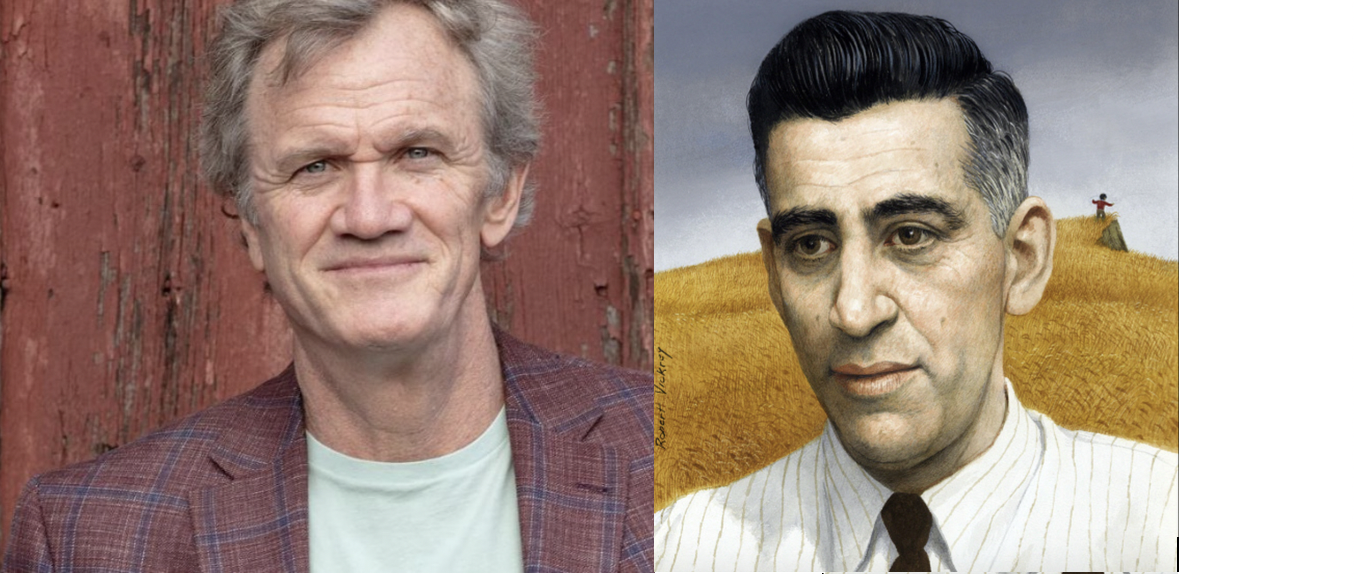
Matt Salinger: “Yes. My father was an author, so he wrote all his life. People seem surprised that he continued to do so without publishing. But he thought that publication was a distraction. My father was a very private person. That’s one of the reasons he didn’t give interviews. He thought they were useless, that everything he had to say was in his books. Maybe he was out of step with his time.”
“What was his connection to his readers?”
“They were almost sacred to him. It was like he was writing directly into the imagination of each reader. That’s why he never accepted any adaption of his books. And that’s why I wouldn’t want it either. There will be no film or series. If Leonardo DiCaprio – him or another actor – plays a character, you will always have his image in your head. You will never be free to imagine it again. My father was a purist. He did not want the reader to be prevented from dreaming or for the reader’s mind to be blurred by minor, outside conceptions. He wanted people to open his books without any prejudice. This year, I have two projects: to help publishers who are working on new editions of Salinger and to set the record straight. I want readers to know that most of the things that have been announced are false. There are biographies that have been published by biographers who have never spoken to him. However, in the absence of contact, they had to feed on rumours. One of these biographies says that there are six books finished that are ready to be printed. But that’s completely false! It goes against my father to say all this. However, I would like to tell readers that what was not published during Salinger’s lifetime will be published. As far as possible. That is, in no less than three years but no more than ten. I think in six years, it’ll all be over.”
“I think Salinger’s most dedicated readers will find treasures in what is released. I don’t know if we’ll publish all at once. It’s still under discussion.”
“Why take so much time?”
“When you have written for forty-five years at the rate of five, six, seven, eight hours a day, every day of your life, there is a lot of work. No one can imagine how much work that is. There are both handwritten and typed sheets to transcribe, double-spaced typed sheets with annotated margins… This requires a lot of transcription time. But I don’t edit anything, I don’t interfere with what he wrote. I think the most dedicated Salinger readers will find treasures in what is released. I don’t know if we’ll publish all at once. It’s still under discussion. There will probably be people who will buy it because they have heard about the Salinger myth. They will certainly be disappointed, but that is not a problem. J. D. Salinger wrote for his readers. I look forward to sharing his writings with these readers.
What are we talking about here? Novels, poems, letters?
It’s not important. What the reader needs to know is that these will be his writings. France despises short stories. However, in my opinion, if you appreciate a writer, you will appreciate everything he or she has produced, whatever the form of what he or she has written. That is why I will not tell you what form his texts will take. To answer your question, then, I read everything my father didn’t publish. But I will not say anything, so that the readers, whom Salinger loved so much, do not have a biased reading of what they will read. It would be a disservice to my father to do the opposite.
Did your father ever talk to you about his work?
Sometimes. He loved to write. It was his great joy, which made him happy. He thought he was doing what “We” – call it God if you wish – expected of him. Sometimes he was electrified about what he was doing and would come out of his office with eyes filled with excitement. Sometimes he would laugh and read me a few lines. But I wasn’t around much. So, most of the time, he didn’t have a confident to read his texts to. Sometimes he would read to his wife. But I don’t know to what extent he did it. He was a very secretive man. He didn’t care much about money. He really lived very simply, modestly. He was an artist. A real one. He wanted to share his writings, nothing else.
“My father studied things so deeply that nothing surprised him.”
Did he know why Catcher in the Rye was so successful?
He never talked about that. I have my own idea on the matter, but would he have agreed with me? I read The Catcher in the Rye when I was eleven and numerous times as I grew up. When I re-read The Catcher in the Rye or Franny and Zooey – which is my favorite – I feel like I hear his voice. But his voice is always there, in me. I thought I was experiencing something unique because I was his son. Then I realized that I had many brothers and sisters when I read it because he had written it in a very personal way for each reader. That’s what makes his writing so beautiful. I think that when you get older, you see things differently. By rediscovering it, you will surely learn things about yourself: how much you have changed, who you were and who you have become. It is whispered that there may be a new translation… But there is nothing official.
[Author’s Note: I’ve read the French version of The Catcher In The Rye and it is dated and stale (Bon Sang ! Le cafard). In another 6 years I hope to have learned and lived enough French to translate a new version.]
What would he think of our world today?
When Trump was elected president, I called my sister. I said, “What person wouldn’t be surprised if we elected this clown?” And she started screaming, “Dad!” Our father was deeply sceptical. He was suspicious of technology. He never had a computer or a mobile phone. He thought Facebook and Google were worrying. Alarming, even. He was a strong supporter of European laws for the protection of personal data. He found the world sad but not surprising. He had this ability to predict events. I don’t think he had this gift of omniscience, but he was a keen observer. He studied things so deeply that nothing surprised him.
Did he believe in God?
It depends on what you mean by “God”. But yes, completely. He has read and studied religions throughout his life. That’s why I don’t think people can understand the depth of his reading, the number of books he’s been able to read. He was attracted to the mystical part of religions but whether it was Judaism, Islam, Christianity, Hinduism, Confucianism… he studied everything. He spent decades analyzing them.
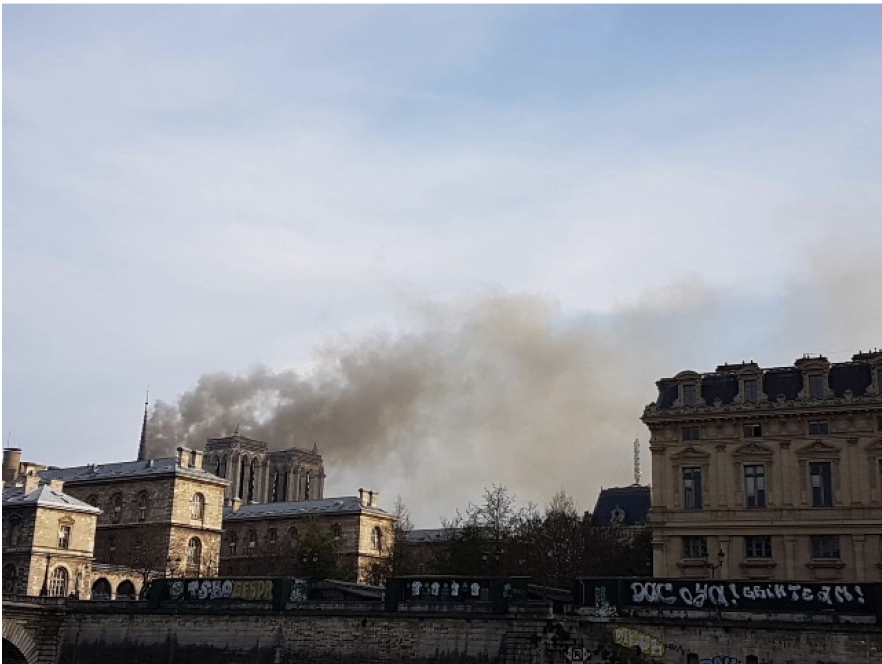
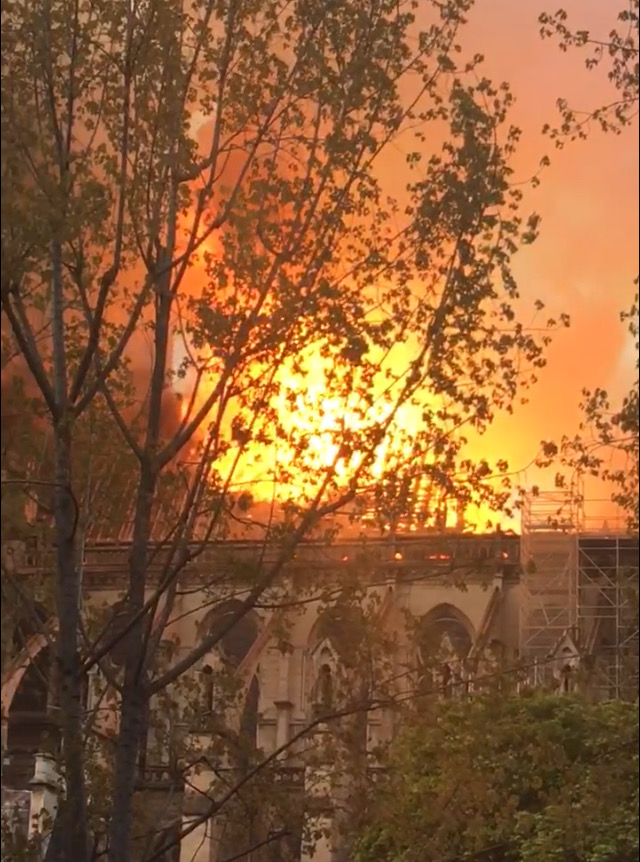
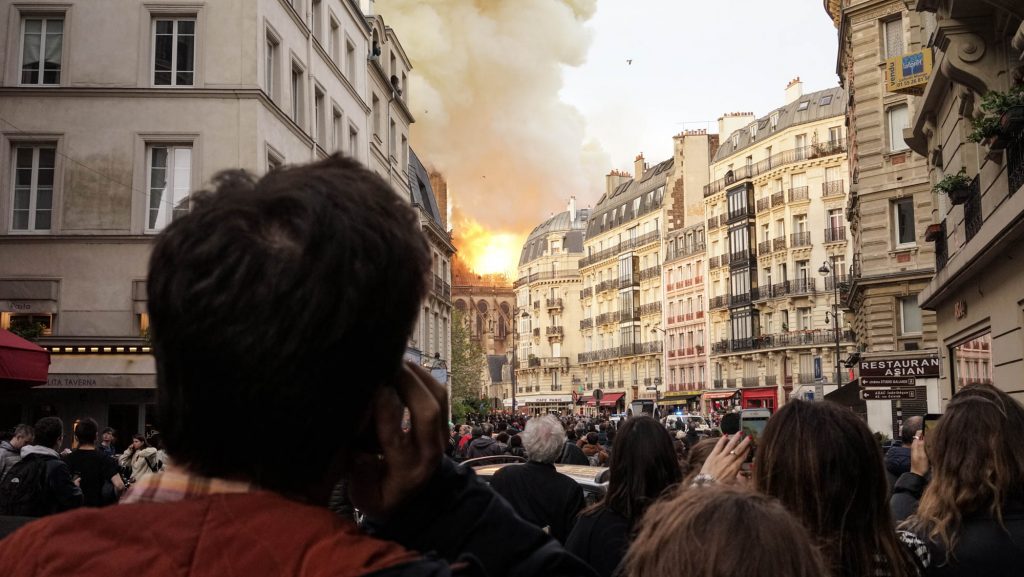
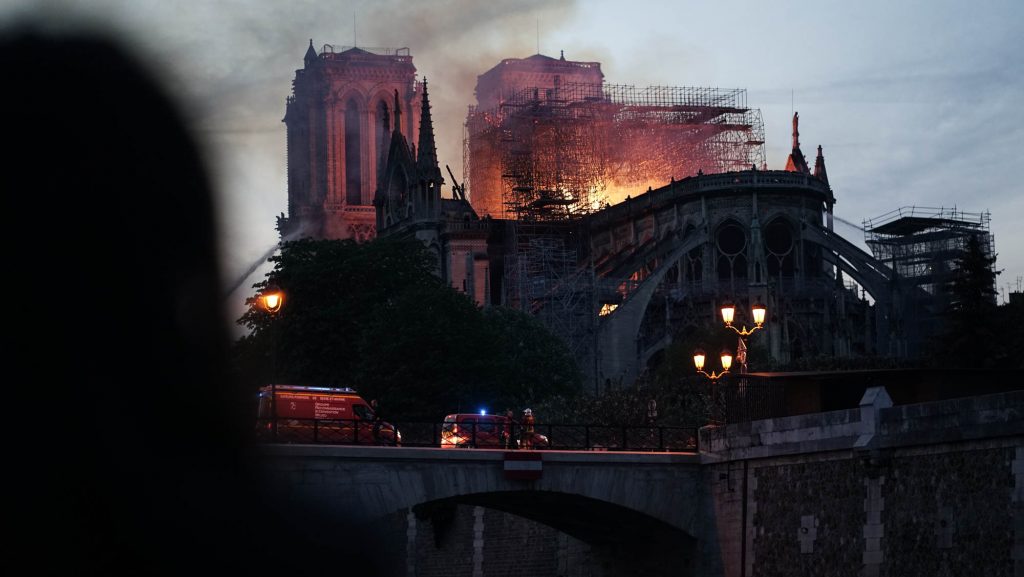
On April 15, 2019 at 6:58pm I was lying on the couch in boxer briefs trying to motivate myself to go grocery shopping when my phone started buzzing non-stop. I looked at one of my journalism group chats and saw this:
The photo was taken by Justine Guerin, then sent to Andrei Popoviciu, who posted it in the group chat at 6:58pm.
Beneath the photo I saw the messages: “Notre Dame” then “Fucking hell.”
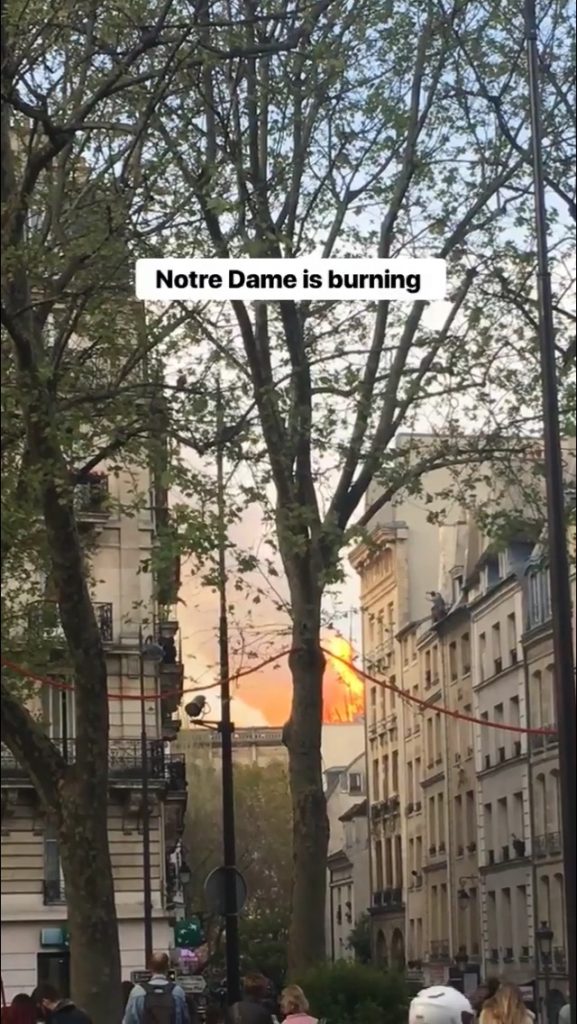
My girlfriend was giving a seminar at La Sorbonne, right near Notre Dame, so I immediately texted her and ran to the metro. We met outside the Maubert – Mutualité stop, embraced, and threaded our way through the crowds to the Seine to get a better view of Notre Dame. My first view of the fire was this (Instagram video):
On my phone I wasn’t able to verify the cause of the fire, I only saw more pictures of smoke on group chats and on twitter.
*
Construction of Notre Dame began 856 years ago, in 1163, and was finished in 1354, so everyone who began the project were dead before they saw the results of their labor. During the early 1800s Notre Dame was neglected and falling apart, until Victor Hugo published “The Hunchback of Notre-Dame/Notre-Dame de Paris,” in 1831, revitalizing interest in the structure. Some great quotes from the book:
“Life without love is only a dry wheel, creaking and grating as it revolves.”
“The consciousness of having spent the other hours to good purpose is an excellent sauce on the table.”
“I would rather be the head of a fly than the tail of a lion.”
“I am a poet. Men of my profession are addicted to walking the streets at night.”
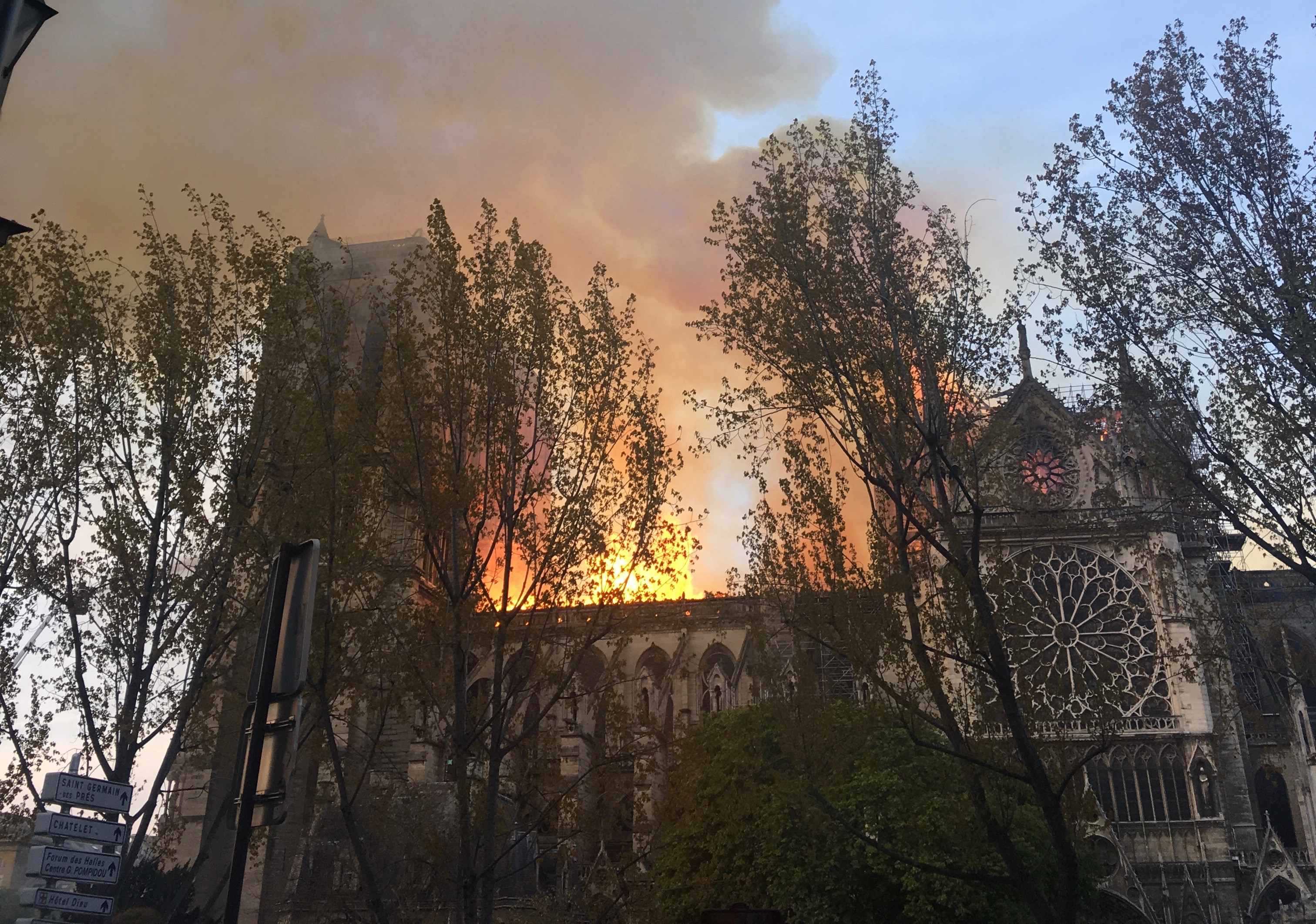
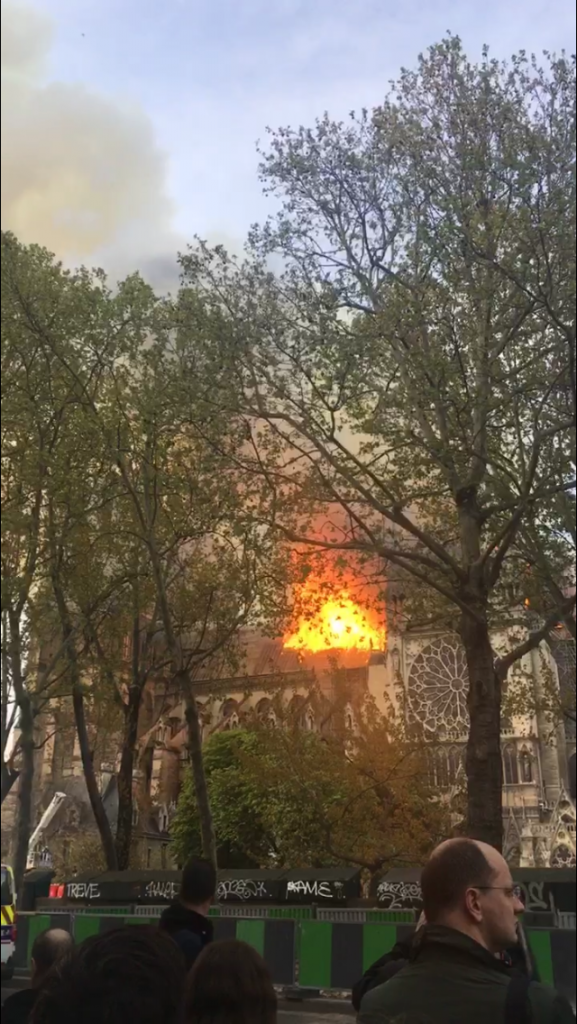
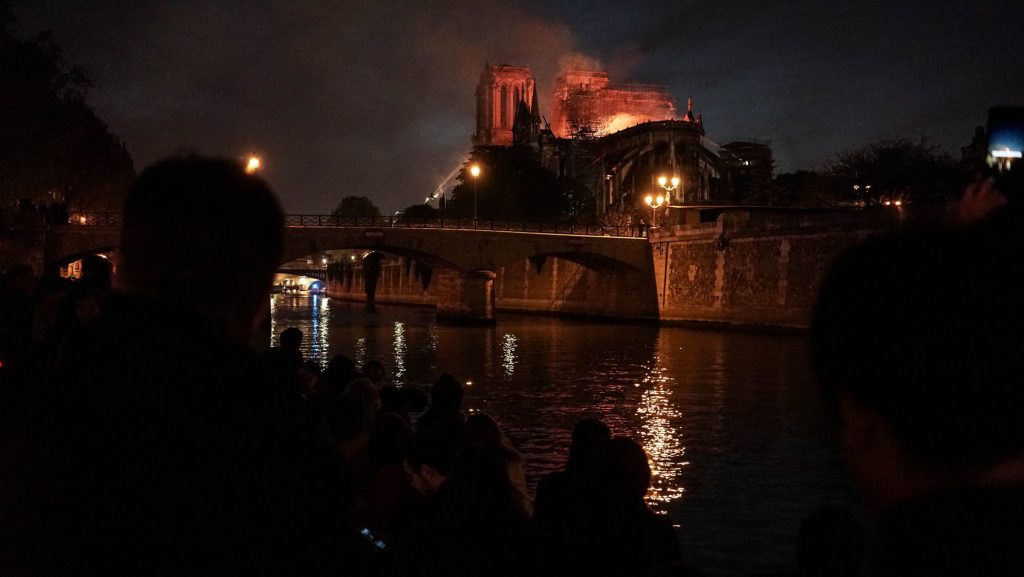
Upon reaching the Seine, the first photo I took of the fire up close was this, at 7:42pm:
The fire was becoming worse and worse, and six minutes later it nearly covered the entire roof:
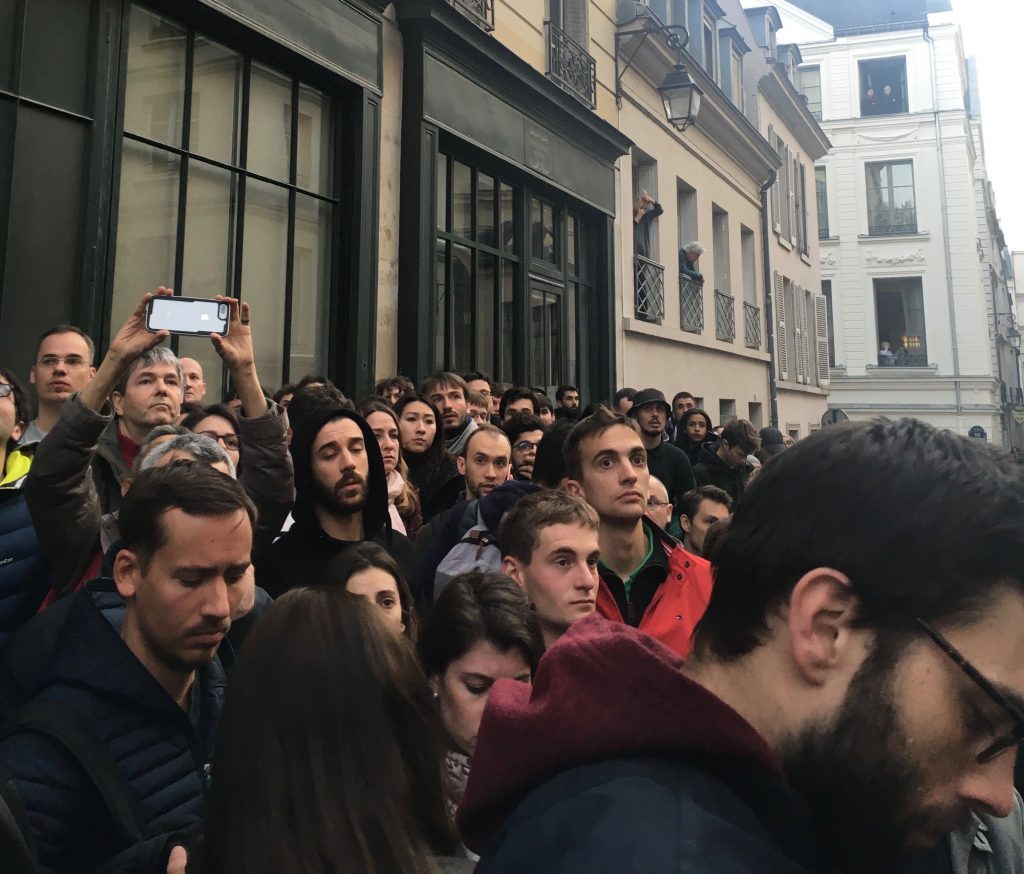
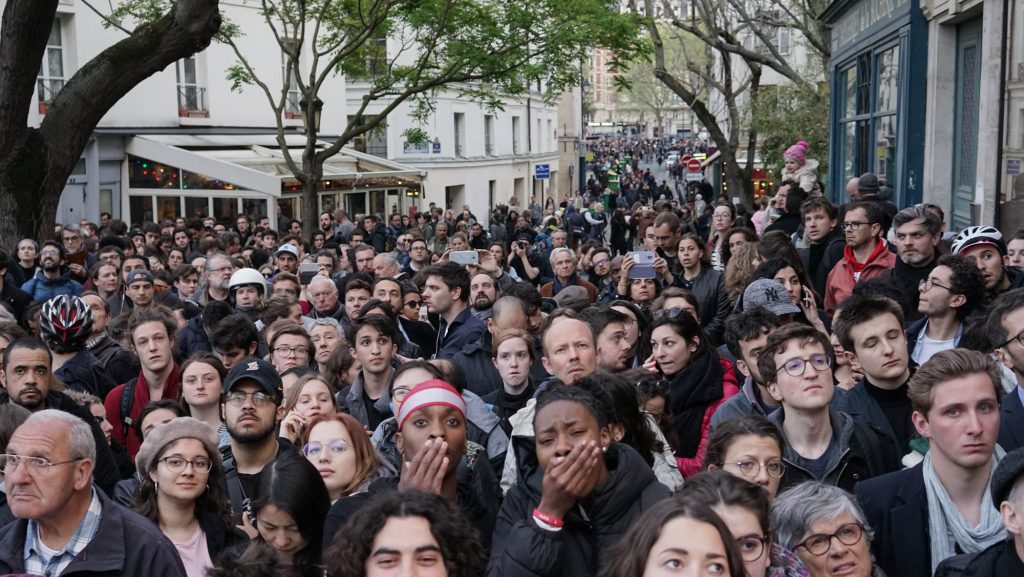
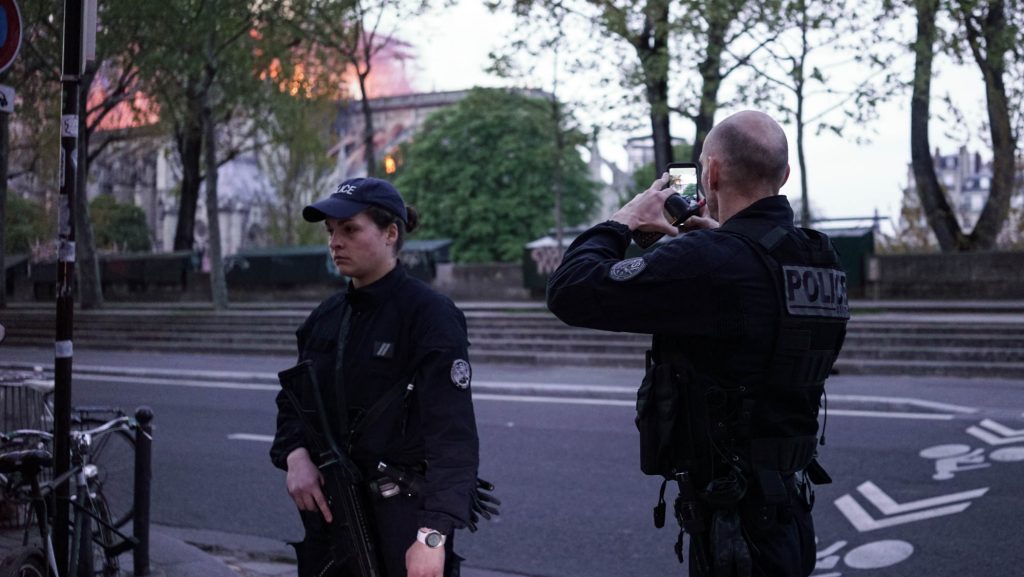
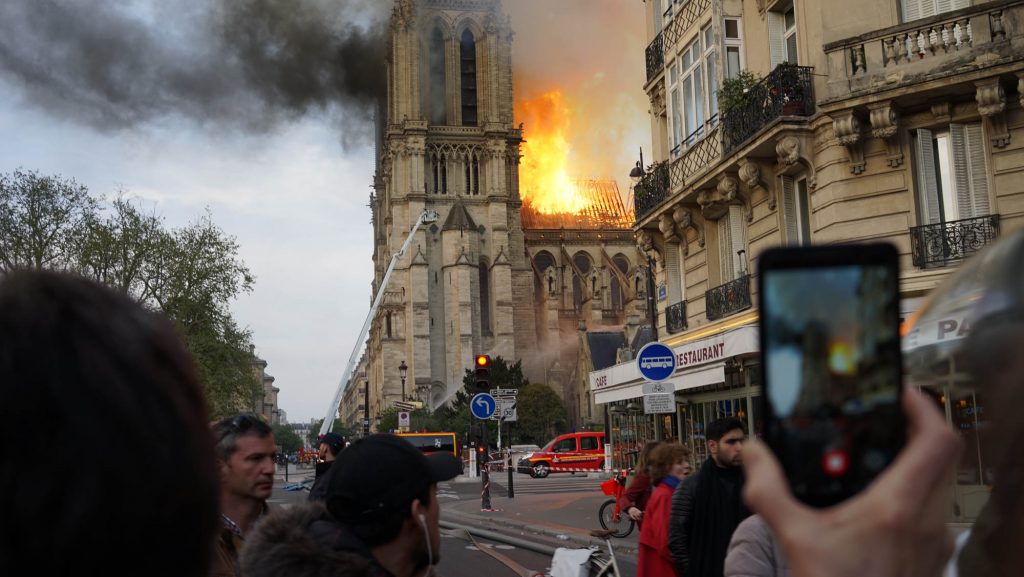
Police had roped off the street. There was a feeling of awe and shock throughout the crowds, murmuring voices, and raised phones. Most of the faces were either solemn or in tears:
J.W. Kash All Rights Reserved
At one point there was someone pushing behind us, and I felt someone open the front pocket of my backpack. When I turned around to confront the thief, the man was already moving quickly through the crowds. Luckily, I had nothing in the pocket besides exploded pens, contacts, and dental floss. Mental note: be careful of your belongings when distracted by disasters.
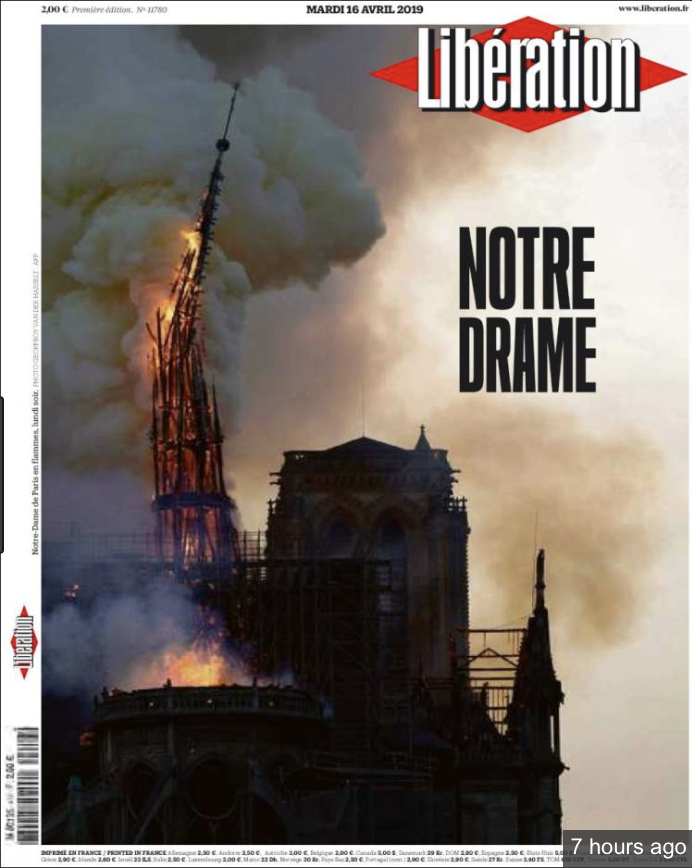
The fire was spreading from north-west and to south-east and destroying the roof. The gothic spire crumbled and fell. The falling spire would be the cover of numerous newspapers the next day.
Worldcrunch.com
Someone nearby mentioned that the cause was being attributed to a renovation accident. But I was suspicious of this…
In 2017, the New York Times wrote an article claiming that the Notre Dame cathedral was in desperate need of renovation. The renovation was expected to cost nearly $180 million. While I was initially suspicious that a renovation accident could cause such a massive and wild fire, subsequent research revealed to me that Notre Dame is quite flammable, and even a tossed cigarette or a spark from a faulty machine could have been the cause.
The fire officially broke out at 6:45pm (13 minutes before I saw it on my phone, the power of social media) at the base of the 93 meter spire, which was constructed out of lead and wood in the 19th century. The fire rapidly spread to the cathedral’s roof that is made up of hundreds of oak beams, some as old as the 1200s. This area is known as La forêt, or the forest. For more details of the potential cause, go here.
At one point a man (probably drunk) started screaming at the police men that it was all their fault. They ignored him.
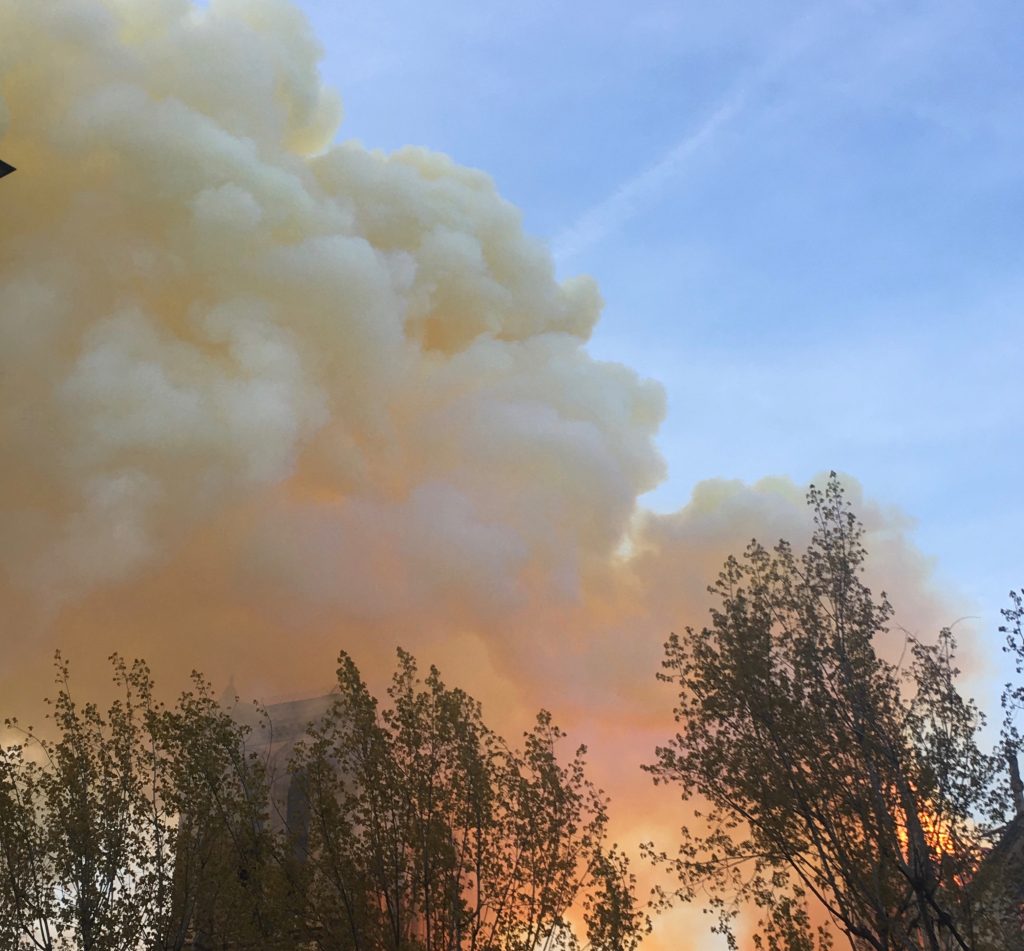
In the distance I saw the outline of a gargoyle completely engulfed in flames, as if at the gateway to hell. Another part of the roof collapsed, sending up a plume of yellow and blue smoke, that I couldn’t help think looked beautiful:
J.W. Kash All Rights Reserved
I saw one of my classmates, Trygve Ulriksen Skogseth, in the crowd with some camera equipment and waved him over. He was in intense-photographer-work-mode, and is one of the best photographers at my journalism school, SciencesPo. Here are some of the photos he took, which he has given me permission to post:
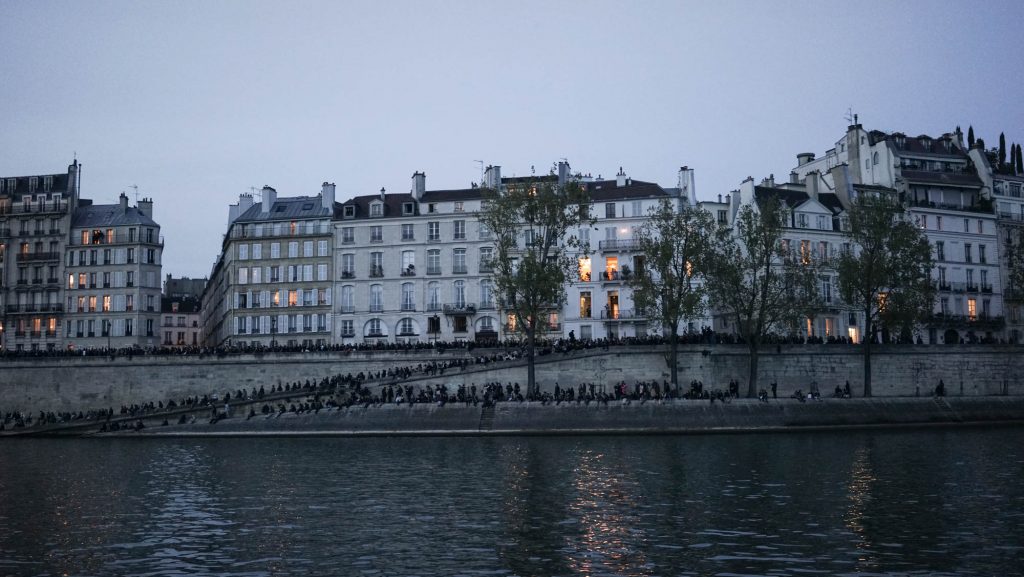
Trygve Ulriksen Skogseth, All Rights ReservedTrygve Ulriksen Skogseth, All Rights Reserved Trygve Ulriksen Skogseth, All Rights ReservedTrygve Ulriksen Skogseth, All Rights ReservedTrygve Ulriksen Skogseth, All Rights ReservedTrygve Ulriksen Skogseth, All Rights Reserved
My girlfriend said, “The air smells like ash, it’s hard to breathe.” But when we turned around we realized that it was just a teenage boy smoking a cigarette right behind us. The air did have a hint of ash because of the fire, but it wasn’t that bad. Paris often smells like smoke.
We left when the roof was gone. I saw a helicopter in the sky, a firefighter at the end of a ladder near the south-east side, and measly streams of water spraying against the north-west parts of the building. Occasionally, you’d hear crashes of debris falling and hitting other parts of the cathedral.
Trygve Ulriksen Skogseth, All Rights Reserved
At 20h00/8pm French president Emmanuel Macron postponed his nation-wide speech called Le bilan du grand débat (debate), and he tweeted (translated into English):
Notre-Dame de Paris is in flames. Emotion of an entire nation. Thought for all Catholics and for all Catholics and for all French people. Like all our compatriots, I am sad tonight to see this part of us burn.
As usual, Trump shared his point of view:
So horrible to watch the massive fire at Notre Dame Cathedral in Paris. Perhaps flying water tankers could be used to put it out. Must act quickly!
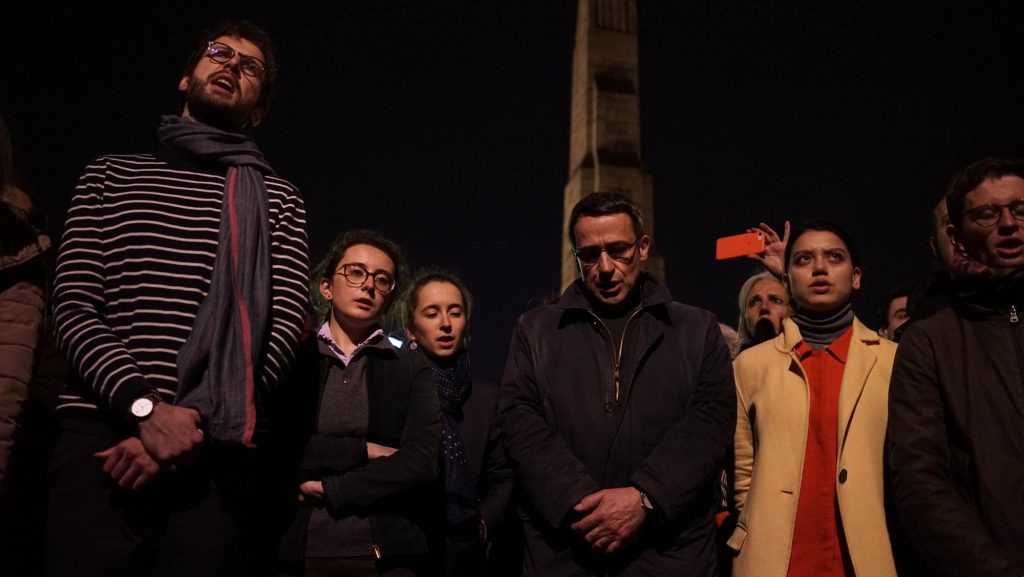
On social media people shared their pictures and memories of Notre Dame. French friends of mine expressed deep sadness, calling it “absolutely horrendous,” “a sense of loss as if I had lost a piece of my identity,” and “heartbreaking.” But a consolation is that through the work of 400 firefighters, 15 hours after the fire started it was extinguished. They were able to save two Belfry towers, the stained-glass rose windows, the grand organ, and many historical relics. A priest helped rescue treasures from the Cathedral. Parisians came together and sang hymns as they watched Notre Dame burning.
Trygve Ulriksen Skogseth, All Rights Reserved
The French billionaire Francois-Henri Pinault and his family have pledged 100 million euros to rebuild the cathedral. Another French billionaire Bernard Arnault, announced he would donated 200 million euros. The mayor of Paris, Anne Hidalgo, announced that the city would make 50 million euros available. The church will be rebuilt. No deaths were reported.
*
While wandering around Paris after leaving the fire I saw people reading novels on the metro and people laughing and drinking outside cafés. There were two men tossing trash into the back of a garbage truck. In a window, somebody was hunched over a desk, consumed by a task. Churches, art, and emotions burn … life keeps moving.
Later that night I received a message from my friend, Martin Goillandeau, who considers “Notre-Dame de Paris” one of his favorite novels. The message contained the prologue to Notre-Dame de Paris, (translated from French to English):
A few years ago, while visiting and wandering through Notre-Dame, the author of this book found, in an obscure corner of one of the towers, this word, engraved by hand on the wall:
ANÁΓKH
These Greek capitals were black with age and carved deeply into the stone. I do not know which signs proper to Gothic calligraphy imprinted in their forms and attitudes, as if to reveal that it was a medieval hand that had written them there, especially the gloomy and fatal meaning they contain, strongly struck the author.
He wondered, he tried to guess what could be the grieving soul who had not wanted to leave this world without leaving this stigma of crime or misfortune on the front of the old church.
Since then, the wall has been brushed or scratched (I don’t know which one), and the inscription has disappeared. For this is how it has gone for the past two hundred years with one of the most wonderful churches of the Middle Ages. Mutilations come to them from all sides, from within and without. The priest brushes them, the architect scratches them, then the people come along, who demolish them.
Thus, apart from the fragile memory dedicated to him here by the author of this book, there is nothing left today of the mysterious word engraved in the dark tower of Notre-Dame, nothing of the unknown destiny that he summed up so melancholy. The man who wrote this word on this wall erased himself, several centuries ago, from the middle of generations, the word in turn erased himself from the church wall, the church itself may soon erase itself from the earth. That’s the word that this book is about. February 1831.
When I read this to my girlfriend, she thought of another quote, by Charles Baudelaire (from le Cygne, The Swan), which perhaps captures the feeling even more simply and eloquently:
Le vieux Paris n’est plus
(La forme d’une ville change plus vite, hélas ! que le coeur d’un mortel).
*
Old Paris is no more.
The shape of the city changes faster, alas, than the heart of a mortal.
Thirty years ago the Louvre Pyramid was called a cultural desecration, with journalists and the Parisian public calling for an insurrection against the structure, but today the monument is celebrated as a resounding success.
The idea for renovating the Louvre came from the charismatic Jack Lang, who in 1981 wrote President François Mitterrand saying, “It would be a good idea to start recreating the Grand Louvre by allocating all the buildings to museums.” Mitterrand scribbled back in a letter, “Good idea, but it’s difficult to realize good ideas.”
Jack Lang continued to push for a renovation, writing that, “The Napoleon courtyard was a terrible parking lot. The museum was handicapped by the lack of a central entrance.” Mitterrand gave in to the requests and hired the architect, Ieo Ming Pei. Mitterrand had always admired Pei’s work in the United States, which included Pei’s modernist extension to the National Gallery of Art in Washington D.C. and the Dallas City Hall.
When I.M. Pei’s model of the pyramid was revealed to the French public in 1984, Jack Lang remembers “an explosion of screams.” The journalist André Fermigier called the design “a house of death.” The academician Jean Dutourd wrote that “uncle wants to be the first pharaoh in our history.” And three historians, Antioine Schnapper, Sébastien Loste, and Bruno Foucart published a book of essays entitled, “Mystified Paris. The great illusion of the Great Louvre.”
The criticisms were focused less on the enlargement of the Louvre as about the aesthetics of the contemporary architecture clashing with the Napoleon III setting. I.M. Pei had never worked on a historic building before. Pei remembers one architectural meeting that was “a terrible session,” where an expert shouted at him, “You are not in Dallas now!” His critics didn’t seem to care that he had won the Prtizker Prize in 1983, the “Nobel of architecture.”
“I received many angry glances in the streets of Paris,” Pei later said, confessing that “after the Louvre I thought no project would be too difficult.”
Pei’s genius was to link the three wings of the world’s most visited museum with vast underground galleries bathed in light from his glass and steel pyramid.
For its current Chairman and CEO Jean-Luc Martinez, the pyramid is a masterpiece that helped turned the museum around. “The Louvre is the only museum in the world whose entrance is a work of art,” he said “and the pyramid has become the symbol of a museum resolutely turned towards the future.”
Pei’s original design was intended for two million annual visitors. Last year 10.2 million people visited the Louvre. This year I.M. Pei is 102 years old, and continues to enjoy the success of his work, which is admired for its beautiful modernity as much as the ancient art it introduces.
The Louvre was not the first museum in Paris to experience hate that was turned to love. The Arche de la Défense, the Centre Pompidou, and the Eiffel Tower all experienced lashing disapproval at the time of their births. In 1887, the Eiffel Tower was attacked by a group of intellectuals (including Emile Zola and Guy de Maupassant) who published a letter in the newspaper Le Temps protesting against the building, calling it “Useless…monstrous…and an odious column of sheet metal with bolts.” And like the Eiffel Tower, the Louvre would survive the barrage of criticism to become one of the most popular structures in the world and a shining symbol of Paris.
This essay is for people who do not consider themselves technologically savvy, who often feel like they’re sinking in the ocean of the internet, but who have a website (boat) or plan to build one (you’re a pirate). This post is also for burgeoning journalists or artists who are not skillful with computers but who want to someday showcase their work online. If you ever took a computer programming class or spent your sad childhood on the internet, please move on to another thing, because when you read my suggestions you’ll likely think, WHAT A SILLY DUMBASS! HOW DID HE NOT KNOW THAT SHIT ALREADY!? Because I spent my sad childhood digging holes in my neighbor’s backyard.
1.) Update your website, plugins, tools, etc. habitually
On January 10th, at the precise moment my loxodonta molar tooth made contact with a king figurine in a Galette des Rois tart cake, my website was hacked by a virus. I named him Neo and tried to kill him. At some point during the 10+ hours I spent on the phone with my domain provider (D.P.) I learned that the cause was my failure to update my website and its plugins. I guess viruses are attracted to old versions of things (future essay: how are wandering viruses created in the first place and how do they find random places on the internet to infect?) According to D.P. the virus was not targeting just my website and its plugin-MILFS, but was a “wide net” searching for bank info, credit card numbers, ways to get cash. As I talked to D.P. on the phone, I could tell by the professionally condescending tone of their voice that they were surprised by my technological ignorance/ineptitude. Here’s my explanation/justification:
I created my website in 2016 with the help of a wordpress freelancer I found through Craig’s list (Sam, a patient Hasidic Jewish man who lives in Bed-Stuy, what are you doing now Sam?) and through mind-numbing youtube videos, and I thought that once my website was created I could forget about the structure and focus on other things besides “up-keep.” I was wrong. If I had simply clicked an update button every once in a while, I would have saved myself 15 hours of stress and uncertainty, 70 euros, and my cyber dignity. While on the phone, on hold, listening to crackling orchestral music, and staring at the swirling water of my petty existence, I couldn’t help but apply a cliché life lesson to this little annoying situation: if you ignore little updates in your life, little adaptions, little up-keep, you’ll have to pay for them in a big way later on. Moral: update, just click that button.
The download is free, takes 1 minute, and once you have it, all you have to do is click the anti-virus button once in a while and it checks all the files on your computer. Another “trick” you can do with an anti-virus scanner is that if you have any files or plugins on your website that are suspicious/can dodge bullets, you can download the files to your computer, then run the scanner. I know this because I had to go into the “back-office” of my website (the webspace provided by my domain provider) download potentially infected files, then run the scanner on each of them. I received an email that looked like this (below)…then spent four hours scanning, please scroll down and enjoy! (So you wanna to smoke a cigarette Jimmy? Well then smoke the whole goddamn pack!)
3.) Last but not least, your website is never safe. Put all your content somewhere else
At some point, I admit, while talking to D.P., watching youtube videos on cleaning infected websites, and attempting to troubleshoot on my own, I almost had a mental breakdown. Why? Because I’ve probably spent over 800 hours working on my website, writing essays, finding pictures, reading sentences out loud to my bulldog Hank to find just the right rhythm (if his jowls twitch the sentence is too clunky), formatting, etc…I have 3875 subscribers (500 are probably robots), and all this would have disappeared if D.P. and I hadn’t been able to get rid of the virus. Of course it would not have been the end of the world if my website died, but my website is something special to me, it’s something I built, like Frankenstein, and it would have been three years of work down the drain if I hadn’t been able to recover it…
I now realize that if I really care about all the work I’ve done, I have to put it all in a word document, then on a hard drive. I suggest you do the same. Then, to be even more safe, bury the hard drive in your neighbor’s backyard.