An Open Letter to Anyone with a Facebook-like Addiction

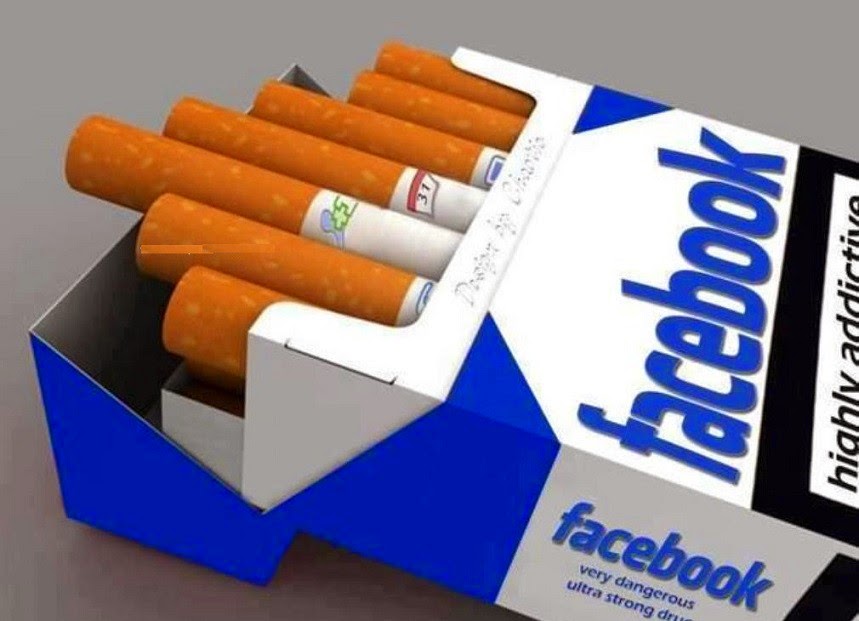
Life is not easy. It’s not easy if you have a facebook, or even if, god forbid, you don’t have one. It’s all about evolution. The people who are popular on the internet are usually better than everyone else and have a better chance of survival. And survival isn’t about putting particular moments of your life online, it’s about putting every shred of experience that means anything at all to you on your public wall: marriage, food, trips, pets, babies, plans, selfies, art, complaints, witticisms, call for donations, political opinions, blog posts, sports observations, or jokes. And when these things are “liked” you subconsciously want to post more and more, until you can’t stop and it consumes your life. Could you survive without facebook likes? Could you make it through one day without your second cousin’s ex-girlfriend’s brother validating your pineapple fried rice with a click of a button?

As a person who has never been a severe facebook-like addict, I can only speak from that perspective. My insight into your world is only through cyber stalking. I do not wish to sit in your comfortable desk chair and post twenty pictures of my dog in an hour. But I can tell you what it’s like to sit in mine – living extended periods of my life without a facebook.

Everyday I have people ignoring things I do and not caring at all about my discoveries or accomplishments. It may seem selfish and narrow, but I believe that the center of one’s being and the best emotions and experiences in one’s life are incommunicable and inexpressible. Yes, I like cyber pats on the back and documentation of what I’ve seen and done. But these pleasurable pricks of validation and ceaseless capturing of what you observe can cover up bigger things like powerful, life-changing emotions, self-development, insights, real laughter, real tears, patience, discipline, and actually listening to the people you’re spending time with. That being said, I believe that the desire for validation is no different for a facebook-like addict or a non-addict.

Daily, there are people out there who don’t care about what you think, observe, or do: this includes your friends, bosses, spouses, girlfriends, and parents – that is just a part of life. Being ignored and feeling angry because you didn’t take a picture of a beautiful sunset is as much as a part of living as joy, happiness, love, and having such a good time you forget to look at your phone. Dying alone and having everything pass away with time is the same for an addict as it is for a non-addict. The difference is how we react to and cope with this loneliness and transitoriness, whether our coping mechanisms are good or bad. I don’t know what hundreds of facebook likes does for an addict to help cope with the void inside of all of us. I don’t know the bursting high of receiving more than a thousand likes on a picture or a video. But I do know that my life would be boring and unsatisfying if I was always concerned with what the internet thought of my new haircut or political stance.

I have no doubt from observing you that you hated every day you were spending hours on facebook. I can see how your life was out of control, spiraling into a pit of hurt, hashtags, and despair. You were so lost that when your best friend came to your pigsty of an apartment and said, “Hey man, want to go on an all-expenses paid trip through the Amazon jungle with my nymphomaniac hot old sister?” you replied,
“Will there be wifi or cell phone service?”
“Probably not.”
“Then no.”

I see your struggles without receiving facebook likes. More pain than joy. It’s a time in your life where the social scales aren’t balanced. You are working so hard to be a real person, when no one is there to react positively to your selfie in a mirror. There are so many confusions. What is the use, you may wonder? Do I even exist?

Being on facebook was the one place where you could craft your identity how you seemed fit. “I’m happy! I’m well-traveled! Look at me with friends! Look at the things I do!” It is a place that always accepted you. The life of facebook-likes you have known for just over a decade. That is the easy path to take.

But please know that the immediate pain and loneliness you will feel without facebook likes, now, will eventually fade.

Just as when my dog, Sheena, died when I was young there was terrible pain for me. I wanted to give her a ten minute belly rub in the morning to wake up her up, but I couldn’t. I flashed back to the good times, walking her everyday after school and letting her sniff around her favorite spot to shit, the neighbor’s front steps, but they were not to be anymore.  I believe my desire to share my sadness with the internet and post pictures of her carcass on MySpace is something you are fighting against. Your old life must die, and there is tremendous pain with death. Each day you will want to post something on facebook to receive a “like” just one more time. And let me warn you that time may heal all wounds, but sometimes the emptiness you feel…when your co-worker’s son’s best friend doesn’t like your video of an orangutan swinging from a tree…lasts forever.

In time, the social scales will balance and you will be able to experience something without the reflexive thought: “I can’t wait to post this on facebook!” But for now, you must travel the difficult path of nobody noticing your life and find the will to be your own, glorious witness. You will become stronger and happier each time you think, “You know what, I’m not going take a picture of that sunrise, I’m just going to look at it and put my arm around my girlfriend,” and, “Hmm, maybe I’ll keep my opinions about the presidential candidates to myself.” It may be hard to see a path without cameras or status updates because the path to recovery is difficult. But please know that you can only walk this path alone – and that life is waiting out there for you to savor and grasp in all it’s brutal, fleeting reality. Just turn away from the screen, my friend, turn away…


Subscribe here:

Jimbo Bimbo’s Modern Art Exhibit Receives Glowing Reviews from Bored, Rich People and Causes the Working Man to Lose Faith in Humanity

“Art is what you can get away with.”

-Andy Warhol

Among other things, childhood is about learning to conform to a preexisting social narrative that necessarily limits cultural free will. The previous sentence is essentially meaningless, but it was published in a reputable art magazine, so it must be profound. The idea which you don’t understand is ostensibly the theme of Jim Bimbo’s art show.

Born in 1988, Bimbo grew up the child of strict parents in suburban Baltimore, and like many upper class American children, he lived in two places simultaneously: the one in a house with rules (make your bed, be kind to the maid, stop crying) and the one outside of it with less rules (here’s some money, we don’t really love you, go have some fun). This sort of dichotomy often prompts a young mind to retreat into a world of its own – a dissociative state evoked here by mixed-media pieces that go into a recondite, defensive crouch. Did you not understand a word or phrase in the previous sentence? Good. Now I seem intelligent and knowledgeable of what I’m talking about.

One sculptural tableau features a pair of formless piles of trash made of aluminum foil and discarded diapers. Both piles wear animal masks rendered in frozen cow dung to resemble fabric hoods, and both are posed by a carved lion (like one you’d find guarding a building) without its head – evoking, perhaps, a vision of childhood fantasy burdened by the demands of acculturation. Do you not know what acculturation means in the previous run-on sentence? (I didn’t know before I wrote this article.) Good. Now I seem even smarter.

Daydreaming interrupted also seems to be the subject of a video fixed on a school entrance as gray, static blurs the image. You can’t make out details of what you’re looking at, so you stand there for a minute and ask yourself why the fuck you just bought a $15 ticket.

tv-static
So deep.

Bimbo returns to adulthood with small, crystal shelves shaped like the balcony of his Manhattan apartment. Yes, can you believe it, he lives in a spacious two-bedroom apartment in Manhattan with a balcony, a fireplace, and a disgruntled doorman who has three children, a used car, and an unpaid mortgage. In another part of the show, a model of an abandoned detergent factory in Bedstuy, Brooklyn being redeveloped as condos offers a view of gentrification undermining artistic agency. It also makes Bimbo feel less guilty about his status and wealth.

Like a lot of millennial artists, Bimbo makes work that risks being about everything and nothing all at once. In other words: complete and utter bullshit. His show takes a lot of explaining, but that doesn’t detract from its cerebral appeal. It simply makes other working artists living on the edge want to kill themselves. •Middle aged rich man attempting to meet a deadline for a reputable art magazine (Bimbo’s exhibit located on 11 Prince Street through Oct 23)


Subscribe here:

The Irish Goodbye

You ever go to a party with your wife and best friend and a few hours later discover they have left together, giggling and drunk, without saying goodbye? You ever go on a first date with someone and after she vomits in your lap on the taxi ride home neither of you contact each other again? You ever get so high at a high school reunion that you think, “I gotta get the fuck out of here. Fast,” and surreptitiously slip out the back door? These are all examples of the Irish Goodbye.
—–
The Irish Goodbye, or Ghosting, or the French Exit, or the Dutch Leave, or the Filer a l’anglaise (just pick an ethnicity you don’t like and add “departure” after it) is when someone leaves a social gathering or a relationship without politely informing the people involved of their imminent departure.
—–
The origin of the Irish Goodbye is believed, by some, to be The Potato Famine:
feature-famine-777x437
When the potato crops failed in Ireland during the years 1845-1852, the Micks left their homeland in droves. One morning a lad would say to his freckled chums, “Just goin on down to the pasture to check on the old croppity crops.” Two hours later: gone. In most cases, the Irish never spoke to their remaining neighbors or friends again. The departure was irrevocable and unspoken, hence the phrase.
 —-
The other, not so sad origin story is that Irish people just like to get obliterated drunk and secretly stumble away:
irishidiot
This cultural preference leads to zombie mode, slurred dedications of undying loyalty, wandering to a back ally for a quick nap, and the remaining friends wondering, “Where is Saucy Sean?”
—–
Social critics ask: Is the Irish Goodbye acceptable? Is it rude? Some reply, “Woah woah woah.” Others reply, “Go go go.”
—–
The Emily Post Institute, an organization dedicated to etiquette, believe it’s improper to not thank the hosts before leaving:
ap_elizabeth_post_sk_131206_16x9_608
Emily Post: “Come back here and make farewell small talk with me…you little shit.”
Others, like Seth Stevenson of Slate, say, “Let’s free ourselves from this meaningless, uncomfortable, good time, dampening kabuki.” (What is kabuki? A Classical Japanese dance drama.)
—–
Tom Jones of the Huffington Post says that, concerning relationships, The Irish Goodbye, “… saves an awkward conversation, an even more awkward face-to-face meeting or a most awkward “Dear Person B” letter. Everyone’s a winner because no one has to hear or say, “it’s not you, it’s me,” “I’m just terribly busy right now” or “for some reason, I just want to punch your face in.”
—–
Buzzfeed made a list of 14 reasons why The Irish Goodbye is the best exit strategy.
—–
It seems today’s consensus is that the Irish Goodbye is socially acceptable. But some people still don’t like it. They want closure. They want a soft landing of slow separation, even if it’s fake and pointless, rather than a harsh severance. When someone disappears without warning, it subconsciously signals that life is always moving on, no matter how hard we try to stop it. We want a nice, wrapped-up ending. Because when we’re at a party and we’re looking for someone who has already left, when we’re searching for them to say goodbye and pretending that there are endings in life, we feel

L’esprit de l’escalier

L’esprit de l’escalier (the spirit of the staircase) is a French phrase which roughly translates to staircase wisdom or staircase wit. It is the epiphany a person has after they’ve left a social situation, where they think of the ideal response (usually to an insult) they never said.

The term was coined by the enlightenment philosopher Denis Diderot:

denis-diderot
I should have…told him…he had…a tiny…dick

While Denis was getting sloshed at the mansion of his buddy, Jaques Necker, he was hit with a remark which left him speechless. Later on, Denis sat at his desk, fuming in his undergarments, and agitatedly wrote: “A sensitive man, such as myself, overwhelmed by the argument leveled against him becomes confused and can only think clearly again when he reaches the bottom of the stairs.”

“The bottom of the stairs” refers to the architecture of Jacques Necker’s mansion. In such a home the reception room, where people engaged in witty banter and busted balls, was on the second floor. To have reached the bottom of the stairs meant that you had left the party and were drunkenly stumbling out to your horse and carriage, pissed off at your social ineptitude.

After reading dusty biographies from Paris archives and scouring historical texts, I’ve been able to reconstruct the conversation between Jacques and Denis which led to the birth of this French phrase. Here is what Jaques said:

jacques-n
Jacques Necker being plump and smug

“So, hmph, ahem, Denis, you’re a freethinking atheist who is also a maniacal materialist. Well, answer me this. Last night the spirit of Jesus Christ visited me in bed and told me you’re an imbecile. (Crowd laughter.) He said you should have listened to your father and stayed in law, instead of living a bohemian existence for ten years and being disowned by your family. (More laughter.) Oh,
and you’re a penniless skeptic, who couldn’t even afford your daughter’s dowry so you had to sell your precious library, always questioning life and thinking about this blasphemous evolution. Well, let me give you some definite answers: I’m richer than you! I’m not a monkey! And I’m right and you’re wrong! (Room erupts with peals of uncontrollable laughter.)

Diderot sits there in silence. After he leaves the party, he finally thinks of the perfect reply:

diderot-denis-image
Disgruntled Diderot

“Your mother’s a dirty whore.”

*

I’ve always been interested in semantic discrepancies between languages concerning particular phrases and ideas. In some Kenyan tribes they don’t have a phrase for “being late.” In the Russian language there are 9 different ways to say “bastard.” In Spanish there are numerous ways to say “I miss you,” one of them being “Me haces falta,” which means “you cause my want,” or “you make my lack.” These discrepancies reveal the culture behind the language, where desires, beliefs, and idiosyncrasies dictate which expressions become more varied, powerful, frequently used, or specific.

The fact that the French have a well-worn phrase for “staircase wisdom,” reveals their culture’s emphasis on witty, biting, and sparing banter. I’ve read many French novels, and in almost all of them there’s at least one scene where people are sitting at dinner table ruthlessly making fun of one another. So it shouldn’t be a surprise that they have a phrase which describes the “spirit” of getting back at someone in a social scenario.

Anyway…to leave on a good note…here’s a picture of moldy, delicious cheese:

Gimme mold.


Subscribe here:

Why does turning malfunctioning electronics off, then on, work technological miracles?

From cell phones to personal computers to multi-million dollar pieces of electronic equipment, turning any of these devices off, then on, is frequently the best and simplest solution to a technological problem. The layman’s impatient neglect of this quick fix is often the bane of an I.T. worker’s existence, as shown in this comedy skit:

So what’s going on? Why does this technique work so well?

The best analogy I’ve read for understanding the inner workings of a computer and this miracle phenomenon is the mailroom.

Like a computer, a mailroom receives many different inputs which have to be organized, categorized, and sent out. If the mailroom is designed and managed efficiently, then the jobs of sorting letters and packages are done easily and smoothly. There has to be enough employees to adequately match the quantity of incoming mail to each set of zip codes. There has to be someone at the front desk to deal with walk-ins. Rolling bins have to be large enough to contain all of the daily packages. Stamps have to be readily available. The mail for the day has to be loaded into trucks. Etc.

Similarly, a computer programmer thinks of as many inputs as he can which a computer will have to cope with, and designs the responding actions which will be applied to these inputs. This piece of mail goes into this bin. This container is rolled to this loading dock at 3pm. Etc. But cyber reality, like our own, is complex and all the possible scenarios can’t be accounted for.

What if a famous actor moved into a zip code that was previously occupied by a low population of unknowns? All of a sudden, 10,000 letters of fan mail are directed to this one zip code, and the worker assigned to this area can’t keep up with the incoming mail. In the beginning of the day, the worker dutifully and successfully piles letter after letter, but soon the stack becomes too high, falls over, and affects the overall organization of the worker’s area. He calls for help from another part of the mailroom (Hey Jimmy! Shit’s hitting the fan!) and the initial problem snowballs and becomes systemic.

What if the famous actor posted on his website a fake address, encouraging his fans to send him a letter if they wanted an autographed photo of him buck naked and riding a polar bear? The poor bastard in the mailroom receives the letters, but doesn’t know where to put them, so he creates a new pile. Again, this new pile clutters the work area and the worker has to call for help. He puts the fake address letters on Jimmy’s desk, and this also slows down Jimmy.

These cascading problems lead to instability and frustration throughout the mailroom. Sometimes, it becomes so bad that everyone in the mailroom just puts their hands up and says, “You know what? Screw this shit. No more work.” That’s when your electronic device freezes.

Instead of getting frustrated and quitting, though, the best solution is to acknowledge the problem, clear everything away, and start from the beginning (a stable state where the majority of testing has been already done). If the people in the mailroom keep working they are only going to make the problems worse. Turning off your electronic device is like an announcement in the mailroom which says: “Everybody clear your desk, close any open files, and return to our initial schedule.” Some things will likely be lost, but the mail that was already sorted into bins and trucks before the disaster will not be affected. Furthermore, the skills and tools for organizing mail for the rest of the day are not affected, but are in fact refreshed and rejuvenated by a return to a known, starting position, a good initial state. Even if the previous problem still needs to be tackled, a return to the initial, known state allows the workers to go through what they were doing again, but this time taking a different path through the code using different variables (“Hey Jimmy, more letters are coming in for that goddamn actor, make room on your desk for me so if this gets out of hand again we have space”).

To conclude, I believe human beings have a similar strategy for coping with snowballing problems and mounting frustration, which is our re-set tool for returning to an initial, known, and stable position:

Sleep.


Before sleeping, subscribe here:

The Artistic Revolutions and Optical Illusions of the Mona Lisa

Last night I a dream about the Mona Lisa involving a Pope hat and tears. Here is my attempt to decipher and educate my corroded and gutter-infested subconscious:

The Mona Lisa is the most widely-recognized, discussed, and studied painting in the history of human civilization. Leonardo Da Vinci created this 30×21 inch masterpiece between 1503-1517 at the request of Francesco de Giocondo, a wealthy silk merchant in Florence. The image is of Francesco’s third wife, Lisa Gherardini, and was commissioned for their new home and to celebrate the birth of their second son. (Although some scholars believe it is either Leonardo’s mother or Leonardo himself disguised as a woman. I believe it is a subtle blend of all three.) The painting never reached the patron’s new home. Leonardo kept the painting until his death, constantly revising the portrait and traveling with it to show off his talents (the picture is neither dated nor signed). Later in life, Leonardo is said to have regretted “never having completed a single work.” He is considered one of the most diversely talented individuals to have ever lived.

The official, Italian name for the painting, “La Gioconda,” is a pun. Gioconda is the feminine form of the patron’s last name (Giocondo) and also means jocund (happy, jovial). The rough translation is: “a light-hearted woman.” My question is, how has this light-hearted woman been able to remain riding on top of the art world (pun intended) for the last 500+ years?

First of all, at the time of its creation, Leonardo revolutionized portrait painting.

Here’s how:

1a.) Before the Mona Lisa, portraits were mostly profiles. They looked stiff and contrived:

angelo-da-siena-small-female-portrait
Small Female Portrait by Angelo Da Siena (c. 1450)

Na. She prude. Fuck that.

La Gioconda was the first image (in Italy) to show a relaxed, informal, three-quarter pose, welcoming the viewer:

best-gia

Yea. What’s up. That’s better.

Leonardo established a new style of portrait painting which has become the standard today.

1b.) Pyramidal composition of the portrait

The painting has a “wide base” appearing heavier at the bottom because of the darkness and the crossing hands. The crossed hands form the base and your eyes are naturally drawn to the apex: the face…where all the “mysterious action” is happening.

1c.) Cropping

Most images of people at the time were “full length.” La Gioconda’s cropping creates a more intimate and “close” atmosphere.

2.) Almost all portraits during this time period rocked bling-bling. Necklaces, bracelets, rings, tight clothes, etc.:

womanbypredisambrogio1475
Portrait of a Young Woman by Antonio del Pollaiuolo (1475)

The Mona Lisa was radical in that she “wasn’t that hot,” (comparatively speaking) and exemplified simplicity and modesty (Freud believed she combined the two, major female traits: motherly tenderness and alluring seductiveness.) Even though she was supposedly a rich merchant’s wife, she “didn’t have a ring on it,” and was wearing loose, poor clothes. Yet her modest crossing of the arms suggested chastity (some scholars even think covering up pregnancy).

Here is a note found in Da Vinci’s, Treatise on Painting, years after his death:

“As far as possible avoid the costumes of your own day…costumes of our period should not be depicted unless it be on tombstones, so that we may be spared being laughed at by our successors for the mad fashions of men and leave behind only things that may be admired for their dignity and their beauty.”

3a.) Paintings at the time used an equal level of detail in the foreground and background:

by Mainardi ca. 1480

I AM A ROBOT

La Gioconda, instead, has a background which gets hazy and out of focus as the distance increases. Just like life.

mona_lisa_detail_background_right

3b.) But despite the life-like perspective of the background, La Gioconda was the first to use an imaginary landscape. The landscape at the left is noticeably lower than the landscape on the right:

mona_lisa_by_leonardo_da_vinci
So much anaconda

And the twisting roads and jagged mountains add to the “other-worldly” feel.

3c.) Leonardo was one of the first artists to use an aerial perspective in the background. The Mona Lisa seems to be sitting in an open loggia (balcony) with dark pillars on either side (scholars are fairly certain the picture was cut off, at first, based on Rafael’s sketch when he was apprenticed to Leonardo in 1504):

09-ml-he-raphaelsketch-03-940x13185-730x1024

 This adds again to the mystical feeling of the background image.

3d.) The horizon is on level with the eyes, connecting the subject with the landscape but also emphasizing the mysteriousness of nature.

horizon-eyes

4.) Contrasting with the shrouded, misty fantasy background is an unprecedented realism in the foreground. In the human figure there is a compete lack of discernible brushstrokes. The anatomy of the hands is perfect. Da Vinci studied over 30 cadavers before beginning this work.

mona-hands
Look at those soft, gentle hands. That’s better than a goddamn photograph.

5.) Combining all of the previous points, the Mona Lisa is intensely human, intensely alive. “On looking at the pit of the throat one could swear that the pulses were beating.“-Vasari. You don’t feel like you’re looking at a picture. You’re drawn in and consumed by her face.

But even if Leonardo revolutionized portraiture, how did La Gioconda last the test of time? After Leonardo’s death, he was greatly respected in the art world, especially by Rafael, who continued his legacy.

But it wasn’t until 1864 that La Gioconda became well-known outside of the art world. And when the “general public” became aware of The Mona Lisa their attention was maintained over generations by one of art’s most enduring traits:

Mystery.

The illusion: the enigmatic smile and gaze. Is she smiling? Is she looking at me?

The smile:

mona-smile

Last year British Art historians “discovered” La Bella Principessa (1496) by Da Vinci:

la-bella

It is clear from this picture that Leonardo worked on his enigmatic smile technique before the Mona Lisa. A study of La Bella Principessa revealed that people believed that she was smiling, or not smiling, based on their distance from the canvas. So Leonardo’s enigmatic smile was intentional.

The gaze:

mona_lisa_eyes

She sees…everything

The eyes seem to follower the viewer. So how did Leonardo accomplish these illusions?

Sfumato:

The definition of form in painting without abrupt outline by the blending of one tone into another. It gives the image a translucent, smoky feel which provides depth and movement. Leonardo blends colors and shades to get gradual transitions between different shapes. No other artist has been able to pull it off as successfully. No one is exactly sure how he did it.

People overestimate the precision, ability, and clarity of their eyesight. Numerous studies reveal that we actually view reality in fragments and piecemeal, while our brain fills in the gaps. Leonardo was somehow able to take advantage of this distortion so that we can’t say for certain whether the Mona Lisa is smiling or where she’s looking.

Side note: La Gioconda used to have eyebrows and eyelashes, but they were removed through overzealous cleaning.

Lastly, La Gioconda has had a tumultuous past which has only added to her fame. Napoleon had the painting in his bedroom, it was stolen from the Louvre (Picasso was suspected, arrested, and thrown in jail), people have thrown acid, a ceramic tea cup, stones, and sprayed red paint at it.  But through it all she has survived…

Will someone ever paint a portrait comparable in its revolt and mystery? I hope so. I’ll keep waiting. I’ll keep looking.

Until then I’ll just have to be satisfied with my absurd and sacrilegious dreams.

Subscribe here:

Eight Simple Steps for Building a Skyscraper

1.) People learn things and pass it on:

For 3800 years of human civilization, the Great Pyramid of Giza was the tallest structure in the world. To build taller without going wider (and to use less than 100,000 slaves and take less than 20 years) we needed new materials, more knowledge, and better technologies…

kheops-pyramid

Such as…

-Steel (thanks to the Bessemer process established in 1854, which removes impurities from pig iron through oxidation, steel could now be inexpensively massed produced.)

-Steel frame construction (using vertical steel columns and “I” beams to create the skeleton of the building. Allowed architects to use curtain walls instead of load bearing walls, rather than “wall bearing” brick and mortar. The Home Insurance building, built in 1885, was the first to use this type of steel-skeleton construction):

steel-girders

-Cheap fossil fuel derived energy (steam locomotives transporting the materials to the site, powering machines, elevators, lighting, etc.)

-Reinforced concrete: invented in 1849 by Joseph Monier. It is concrete in which steel bars are embedded to increase its tensile strength.

-Passenger elevators: first one was built in 1857, located in the  E.V. Haughwout department store in NYC:

passengar-elevator

(Don’t fart in that thing)

2.) Some people get together and make a plan:

The plan must be economically and politically feasible. Architecturally speaking, we have many designs and capabilities to build skyscrapers taller than most of them currently are, but these plans rarely make economic sense. Questions have to be answered such as: What is the real estate market like and where is it going? Should we have both office and residential space? What are the zoning regulations? The air rights? What is the future of the surrounding neighborhood? Do the city officials approve? Can we get financing and all the necessary permits? Questions spiraling towards insanity ad infinitum. Building a skyscraper is like making a ridiculously complicated movie (with many different roles and a high level of coordination) except there are no double takes, timing is even more crucial (elevator installation can’t occur before the frame is up) and safety is even more of a serious concern. Numerous tests are performed before construction (windproof, fireproof, earthquake proof?) and different plans are frequently swapped (are the living and working spaces conveniently accessible and comfortable?)

Civil engineers are faced with a paradox: the only way to test for failure is to to test for all modes of failure. But the only way to know of all modes of failure is to learn from previous failures. This means that engineers can never be absolutely certain that the structure will resist all loadings, but can only have large enough margins of safety such that failure is acceptably unlikely.

Similarly, the financially viability is often, pun intended, up in the air. Both the Chicago spire (would have been the tallest structure in the Western Hemisphere) and the Russian tower in Moscow were canceled due to the global financial crisis of 2008. Sometimes the money runs out…

Nonetheless, despite the structural and financial uncertainties….

3.) Round up the team:

You need architects, mechanical engineers, structural engineers, electrical engineers, civil engineers, interior designers,
elevator consultants, acoustical consultants, geotechnical consultants, dancing midgets, marketers to sell the space, a construction team, including the general contractors and their sub-contractors.

4.) Dig a hole. A big hole.

The hole for the Lotte Jamsil Super Tower in Seoul. Estimated completion time: December 2016

Often the hole is a few stories deep. They dig until they hit bedrock. When the World Trade Center buildings were built more than a million cubic yards of soil and rock were removed and dumped into the Hudson River. There are many skyscrapers in NYC, not only because of the high cost of land, but because the bedrock is near the surface in midtown and lower Manhattan.

This Indian man shares my enthusiasm:


5) Install the footings (big pads to spread out the weight)

These pads spread out the weight of the building in the bottom of the pit. Keep in mind that in most building designs, the weight of the structure is much larger than the weight of the material that it will support. In architecture jargon, the dead load, i.e. the load of the structure, has to be larger than the live load, the weight of things in the structure (furniture, paperclips, taxidermied pandas, etc.). As such, the amount of structural material required within the lower levels of a skyscraper will be much larger than the material required within higher levels.

6.) Raise the frame:

This part usually takes less time than most people expect (sometimes only a few weeks). The frame is raised with the help of cranes. There are 3 ways for cranes to rise within a building. You can read about that here: Cranes. Cranes can build themselves.

The skyscraper must be able to withstand strong winds (the lateral wind load governs the structural design in Supertall buildings, higher up = higher wind pressure). Modern buildings are able to swing a few meters in each direction.

7.) Construct the inner elements: staircases, corridors, air conditioning, heating, electrical systems, chamber of secrets, drainage systems. Most importantly: elevators. The elevators take up a lot of valuable space…which infringes on the economic benefits of the floor space. Also, the concrete core walls must be constructed. These are made of thick concrete, typically around the elevators, and they are the primary system to resist wind and earthquakes.

8.) Party at the top of the skyscraper with vane, Russian photographers:


Subscribe below:

Sources:

http://m.huffpost.com/us/entry/5086779http://www.english-online.at/art-architecture/skyscrapers/skyscrapers.htmhttps://www.quora.com/How-is-a-skyscraper-builthttp://www.bible-history.com/resource/ff_giza.htm

https://thevaliens.com/how-to-with-the-valiens/hand-made-repairing/construction/building-a-skyscraper/

https://www.mhi-global.com/discover/earth/issue/history/history.html

http://madridengineering.com/challenges-of-skyscraper-      construction/

Why does skin wrinkle with age?

If I make it past the age of 40 without my heart or brain exploding (unlike my favorite author, Thomas Wolfe, who died at 37 and when the doctors trephined his skull a burst of pressurized cranial fluid spurted across the room) I look forward to the day when my skin starts to wrinkle. Like a young boy admiring the hair follicles in his armpits blossom, I will observe the decaying and folding of my epidermis with a glowing satisfaction and a quiet pride. Why yearn to re-live the smooth-faced glories and taut energies of youth? I can go back to those fickle, ungracious, boisterous days in my sagging, thinning, white-haired head.

Interesting enough, a biopsy of a wrinkle reveals no obvious signs that it is any different from the rest of your skin. So why am I becoming a bulldog?

The development of wrinkles is a multi-factorial process of intrinsic and extrinsic aging.

Intrinsically, your skin is producing 1% less collagen each year after the age of 20. Collagen is the most abundant protein in the human body (30%). If your body is a house, preferably a brick house, then collagen would be the scaffolding. Less collagen means your skin is thinner and more fragile.

As we hurtle towards death, our bodies also produce less elastin. Elastin is a protein found in connective tissue which allows our bodies to resume their shapes after stretching or contracting. Elastin is like a rubber band:

But if you strain the springiness of the elastin too much/too frequently, the skin has difficulty springing back, and you develop grooves in your skin. This happens with repeated facial expressions such as squinting and laughing which is why young people can develop crows feet and other various lines. For me, I’ve already developed lines on my forehead from spending the majority of the last 26 years lifting my eyebrows in a questioning glance then furrowing my eyebrows in profound thought.

The two proteins mentioned above work together to keep our skin firm and resistant. Collage is the strength upon which the outer layer of the skin is anchored (located in the lower layers of the dermis). Elastin is responsible for the softness and elasticity of the skin (located in the middle layer of the dermis).

The third, crucial component of our skin are glucosaminoglycans (GMCs). This component is the final piece of our skin’s extracellular matrix…

So close.

GMCs are polysaccharides or amino sugars. Together with water, GMCs create a fluid which fills the space between the collagen and the elastin fibers. GMCs are water-binding substances which provide a turgidity or a firmness to our skin. This is one of the reasons why drinking lots of water can promote smooth, healthy skin and make your cheek feel like a baby’s fat ass.

As we plummet towards the grave, our sweat and oil glands also break down. The outermost layer of our skin is covered by an oil called sebum, which lubricates and protects our skin. The sebum is our natural raincoat. It is when sebum is removed from our skin during a prolonged submersion in water that our fingertips and feet become all pruny. Once the oil is gone, water becomes waterlogged in the epidermis. Why doesn’t the rest of our skin get pruny? Because the thicker layer on our feet and hands contain more dead skin cells than any other part of our body. Dead skin cells pull more aggressively on the lower layers and swell more easily than living cells. Unlike a raisin, our skin doesn’t get pruny because of shrinking, but because of expanding.

Extrinsically, our skin ages because of the sun and environmental damage (smoking, pollution). According to a study by the Journal of Clinical, Cosmetic, and Investigational Dermatology,
damage caused by UV rays accounts for at least 80% of skin aging.

UV rays penetrate our skin and damage the collagen and elastin fibers. In response to this damage, our body produces metalloproteinasas. Some of these enzymes break down the collagen further and the result is an uneven formation (matrix) of disorganized collagen fibers called solar scars. Repeat this abnormal skin rebuilding process over decades and you get wrinkles dinkles.

In addition, during the UVA attack break-down process, oxidants or free radicals are produced. Excessive amounts of these oxidants will damage our cells (they steal energy from them) and can even alter their genetic material.

cell-process

If you’ve read my post on “Fred and the Trap house” you will remember that I asked the question: “why does black not crack?”…because Fred is 47 but doesn’t have one wrinkle. Answer: Black skin produces more melanin than white skin, which fights against (absorbs and disseminates) UV rays and prevents DNA damage. An albino is someone whose body doesn’t produce any melanin. Studies also show that black skin produces larger amounts of sebum.

Smoking also causes excess oxidants. In a study of identical twins, the smoker was found to have thinner skin (by as much as 40%). And in another study of women, the smokers were found to have less secretions of Vitamin E in their skin, and Vitamin E is believed to be an antioxidant.

Every year Americans spend 12 billion on cosmetic procedures to hide the signs of aging.

Every year Americans spend millions of hours staring at mirrors worrying about Father Time ploughing creases in their face.

Not for me.

Subscribe here:

Sources:

http://www.scientificamerican.com/article/why-does-skin-wrinkle-wit/

http://www.nytimes.com/health/guides/symptoms/wrinkles/print.html

http://mobile.abc.net.au/news/2015-11-18/how-uv-light-damages-our-skin/6856742

http://www.blerdnation.com/blog/a-little-science-behind-the-phrase-black-dont-crack

http://www.mayoclinic.org/diseases-conditions/wrinkles/basics/causes/con-20029887

http://www.dailymail.co.uk/health/article-2467385/Suns-UV-rays-account-80-cent-skin-wrinkles-ageing.html

http://m.kidshealth.org/en/kids/wrinkly-fingers.html?WT.ac=

http://www.annmariegianni.com/whats-difference-collagen-elastin/

http://blackgirlnerds.com/black-dont-crack-sort-of/

http://wonderopolis.org/wonder/why-does-your-skin-get-wrinkly-in-water-2